
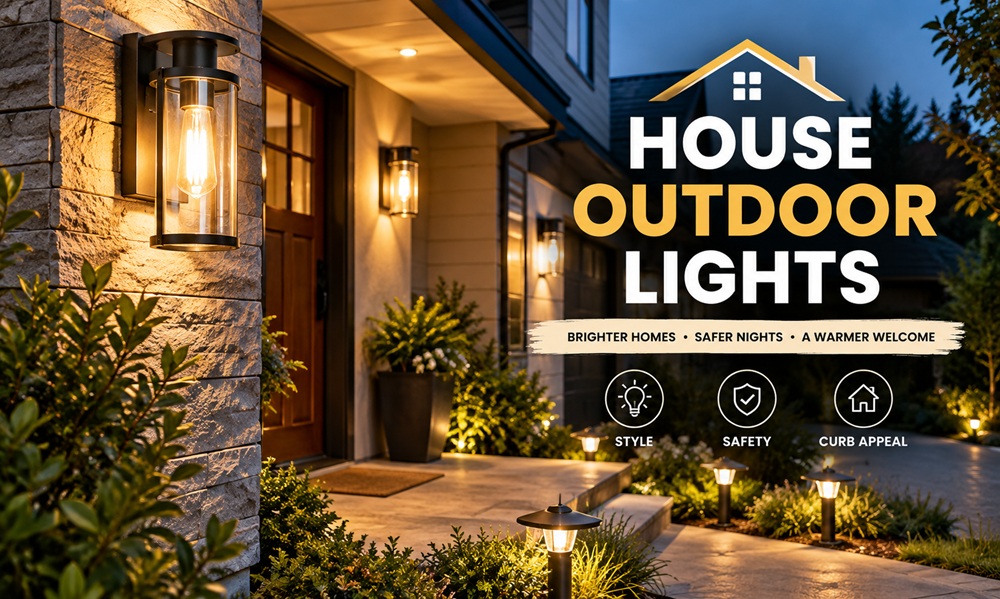
The biggest decision with house outdoor lights isn’t the style. It’s how the lights get their power, because that choice affects how bright they can be, how reliable they are in winter, and how much work the installation takes. Pick the wrong power source for the spot and you’ll end up with lights that are dim, unreliable, or a hassle to maintain.
The Short Comparison
| Power source | Best for | Main drawback |
|---|---|---|
| Hardwired | Entry doors, garages, permanent wall lights | Needs wiring, often an electrician |
| Low voltage | Paths, gardens, decks, accent lighting | Needs a transformer and cable runs |
| Solar | Decorative spots with plenty of sun | Output depends on weather and season |
| Plug-in or battery | Renters, temporary setups, small areas | Limited reach and runtime |
Most homes end up using more than one type, with hardwired lights where reliability matters and something simpler elsewhere.
Hardwired Lights
Hardwired fixtures connect to your home’s electrical system, and they’re the standard for front doors, garages, and any spot that needs steady, bright light every night. They can use full line voltage, so they can be as bright as the job requires, and they work in any weather and in any season.
The tradeoff is installation. Replacing an existing fixture is a manageable task for many homeowners when the power is off at the breaker. Adding a new location means running cable, mounting weatherproof boxes, and often following local code, and that’s the point where a licensed electrician earns their fee. Wiring that’s old, damaged, or poorly grounded is another reason to hire someone.
Hardwired lights also pair well with switches, timers, photocells, and smart controls, so you get automation without extra gadgets.
Low Voltage Lighting
Low voltage systems use a transformer plugged into an outdoor outlet or wired to a circuit. It steps household power down to a safer level and sends it through cable to the fixtures. This makes them popular for garden beds, pathways, deck rails, retaining walls, and tree uplights.
Their big advantage is flexibility. You can bury the cable shallowly, move a fixture when the plants grow, and add more fixtures later, up to the transformer’s capacity. The lower voltage also makes the work more forgiving for confident do-it-yourselfers.
Plan the layout with some care. Long cable runs and too many fixtures on one line can cause lights at the far end to look dimmer, so follow the manufacturer’s guidance on capacity and cable length. Use quality connectors, too, since cheap ones corrode and cause flickering.
Solar Lights
Solar fixtures need no wiring at all. A small panel charges a battery during the day and the light turns on at night. That makes them easy to place almost anywhere, and they cost nothing to run.
Their limits are real, though. They need decent sunlight to charge, so shaded areas, short winter days, and long cloudy stretches reduce brightness and runtime. The batteries also wear out over time and may need replacing. For these reasons, solar works best for gentle decorative light along a garden path or fence rather than for security or main entrances.
If you go solar, put the panel where it gets direct sun even if the light itself points somewhere shadier. Some models have a separate panel on a cable for exactly that reason.
Plug-In and Battery Lights
Plug-in lights run from an outdoor outlet using a weather-rated cord, and battery models run on replaceable or rechargeable cells. They’re useful for renters who can’t alter wiring, for seasonal decorations, and for quick fixes in an area that needs a bit of light.
Use only cords and outlets rated for outdoor use, and keep connections off wet ground. Covered outdoor outlets or in-use covers help protect plugs from rain. Battery lights are convenient but need regular attention, so they suit small areas better than a large property.
Plan Before You Buy
Take a night walk around the house and sketch the areas that need light. Mark where outlets, switches, and existing fixtures already are, since those spots are the easiest to use. Think about which areas need dependable light every night and which only need an occasional glow.
Next, count how many fixtures you’ll need and how far they sit from the nearest power point. Distance is the hidden cost with outdoor lighting. A fixture that looks cheap can become expensive once you add cable, conduit, boxes, and labor to reach it, so it often pays to cluster new lights near an existing power source.
Weatherproofing and Safety Basics
Whatever the power source, keep connections dry and protected. Outdoor outlets should have covers that close over the plug, and extension cords should be rated for outdoor use. Ground fault circuit interrupter protection, usually built into outdoor outlets in modern homes, shuts power off quickly if something goes wrong in wet conditions, so test it periodically using its built-in buttons.
Never run a standard indoor cord outside, and avoid burying cable that isn’t rated for direct burial. If you smell burning, see scorch marks, or find a fixture full of water, switch off the circuit and have it inspected.
Smart Features Worth Considering
Whichever power source you choose, a few smart features can make your lights more useful.
Photocells switch lights on at dusk and off at dawn. Motion sensors save energy by raising the light only when needed. Timers let decorative lights turn off at a set hour. Smart plugs, switches, and bulbs allow phone control, scheduling, and in some cases dimming or color changes.
Check compatibility before you buy, especially if you plan to use dimmers. Not every LED bulb works with every dimmer, and mismatches cause flicker or buzzing.
Maintenance by Type
Each system asks for a little different care. Hardwired fixtures mostly need clean glass and a periodic check of seals. Low voltage systems benefit from a spring check of connectors, since buried cable can get nicked by garden tools. Solar panels should be wiped clean so dirt doesn’t block charging, and batteries should be swapped when runtime drops. Plug-in lights deserve a quick look at cords and plugs for cracks before each season.
What They Cost to Run
Prices vary by region, bulb, and hours of use, so there’s no single number that fits every household. A few things hold true nearly everywhere. LED bulbs use much less electricity than older incandescent or halogen bulbs and last far longer. Controls that shut lights off during the day or late at night cut costs further. Solar lights have no running cost but may need new batteries now and then.
If you want a real figure, check the wattage on the bulb, multiply by hours used per night, and compare that to your electricity rate on your utility bill.
Choosing by Situation
If the light protects a door, garage, or main walkway, go hardwired and use a sensor or timer so it works without thinking. If you’re lighting a garden, a path, or a deck and want flexibility, low voltage is the better fit. If you want a little ambiance in a sunny spot with no outlet nearby, solar will do. If you’re renting or decorating for a season, plug-in or battery lights keep things simple.
Most homes need a combination, and that’s perfectly reasonable. Match each area of the house to the power source that fits its job, and your house outdoor lights will be reliable where it counts and flexible everywhere else.