

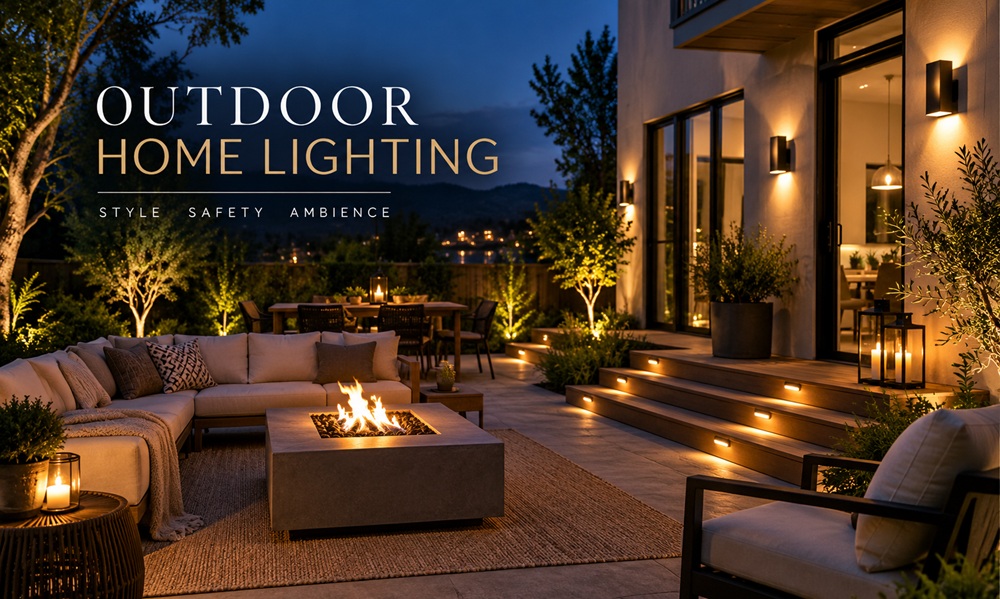
Outdoor home lighting works best when it fixes a specific problem rather than just adding more fixtures. Most people buy lights because something bothers them, like a dark step, a bare wall, or a yard that feels uneasy at night. If you work out which complaint matches your house, the shopping gets simpler and the money goes further.
If You Can’t See Where You’re Stepping
Safety is the first job. Falls tend to happen at steps, uneven pavers, and the point where a path meets a driveway. Lights that fix this need to put illumination on the ground, not just into the air.
For steps, small fixtures set into risers or tucked beneath the tread edge show each drop clearly. For paths, low fixtures with downward light create soft pools along the way. Wall fixtures near entrances help too, but only if they actually reach the lowest step, which is easy to miss when you’re standing at the door looking out.
If your problem is a dark transition between the garage and the front door, a wall light at the corner of the house or a motion activated fixture over the walkway often covers it without any digging.
If the House Looks Flat or Forgotten at Night
Some homes look attractive at noon and disappear after sunset. That’s usually a sign that the only light comes from a single fixture at the door.
Adding a bit of light to the wall surface changes the whole impression. A fixture mounted a short distance from a brick or stone wall, aiming up, brings out texture. A pair of small spotlights aimed at a tree or tall shrub gives the front yard depth. Even a simple wash of warm light across the siding makes the house feel finished.
The trick is restraint. Two or three well placed accents do more than a dozen bright spots. If you can see every fixture, you’ve probably used too many.
If Light Feels Glaring Instead of Welcoming
Glare is the most common complaint after an install. It comes from bare bulbs, clear glass, and fixtures aimed at eye level.
You can fix most glare without replacing everything. Swap clear bulbs for frosted ones or choose fixtures with shades and shields that hide the light source. Lower the brightness, since lumens at the door rarely need to match what you’d use on a work site. Change the aim of any floodlight so it points downward, not outward.
A warmer color also reduces the harsh feel. Bulbs in the 2700K to 3000K range look gentle against most exteriors, while very cool bulbs can turn a nice porch into something that feels like a parking structure.
If You Want Security Without Lighting the Whole Block
Security lighting doesn’t have to mean a blazing floodlight all night. Many people get better results from lights that stay low and steady in the background, with brighter light that comes on only when something moves.
Motion sensing fixtures on side yards and back corners fit this approach well. Aim them so they cover the approach to windows and doors, mount them high enough to be hard to reach, and adjust the sensitivity so a passing cat or a tree branch doesn’t trigger them every few minutes. Pair them with a soft, constant light near the main entrance so the house never looks fully dark.
Remember that a well lit house also needs well lit sight lines. Overgrown shrubs next to a window can block both light and visibility, so a little pruning helps as much as a new fixture.
Choosing Bulbs and Fixtures Once You Know the Problem
With the problem clear, the product choice gets narrower.
Look for fixtures rated for the amount of weather they’ll face. A wet location listing suits anything exposed to rain, while a damp location listing works for covered areas. Solid finishes like powder coated aluminum, brass, and stainless steel resist corrosion better than bare steel.
LED lighting makes sense for nearly every outdoor spot. It lasts a long time, handles cold well, and uses far less power than older bulbs, which matters when lights run most of the night. When you read a package, pay attention to lumens for brightness and Kelvin for color, and ignore the wattage equivalents.
A few additional details are worth checking.
- Beam spread tells you whether the light is a tight spot or a broad wash.
- A high color rendering rating makes brick, wood, and plants look more natural.
- Enclosed fixtures need bulbs approved for enclosed use.
Power and Controls Without the Headache
Outdoor lights get power in a few ways. Hardwired fixtures suit entrances and garages. Low voltage systems, which use a transformer and thin cable, are friendlier for gardens, paths, and accent lighting. Solar works for decorative spots with strong sun, and plug-in lights suit temporary or rental situations.
Controls matter as much as fixtures. A photocell switches lights on at dusk and off at dawn. A timer keeps decorative lights from burning all night. Motion sensors save energy where constant light isn’t needed. Smart switches let you group fixtures and change schedules from a phone, which comes in handy when you travel.
When a project involves new wiring, buried cable, or changes to an existing circuit, bring in a licensed electrician. Outdoor electrical work has to deal with moisture, and mistakes there are the kind that cause real harm.
A Starter Setup for an Average Home
If you want a place to begin, this is a sensible first round for a typical single family house.
- Replace or add fixtures beside the front door, and light the house number.
- Add a light above or beside the garage, with a sensor if the driveway is dark.
- Place a few low path or step lights wherever the ground changes level.
- Cover side yards and back doors with one downward facing sensor light each.
- Add accent lighting on a favorite tree or wall once the basics are done.
That order tackles safety and security before decoration, and it spreads the cost over a few weekends rather than one big purchase.
Maintenance That Keeps Lights Working
Outdoor lights rarely fail overnight. They fade slowly, and a few small habits catch problems early. Wipe lenses a couple of times a year, since dust and pollen cut output more than people realize. Check seals and caulk before winter, and look for moisture inside glass. Trim plants that have grown over path lights or sensors. If one fixture looks dimmer than its neighbors, replace the bulb or module so the set stays even.
Thinking About Budget
Prices vary by region, brand, and installation, so there isn’t one number that fits every house. A few principles still hold. Spending a bit more on weather resistant fixtures usually costs less over time than replacing cheap ones every couple of seasons. Cutting the number of fixtures often saves more than choosing cheaper ones. And good controls, like a photocell or timer, reduce running costs without reducing how the house looks.
If you’re unsure where to start, spend one evening walking the property with a flashlight and noting what’s dark, what’s glaring, and what’s invisible. That list is a better shopping guide than any catalog, and it keeps your outdoor home lighting focused on what you actually need.