

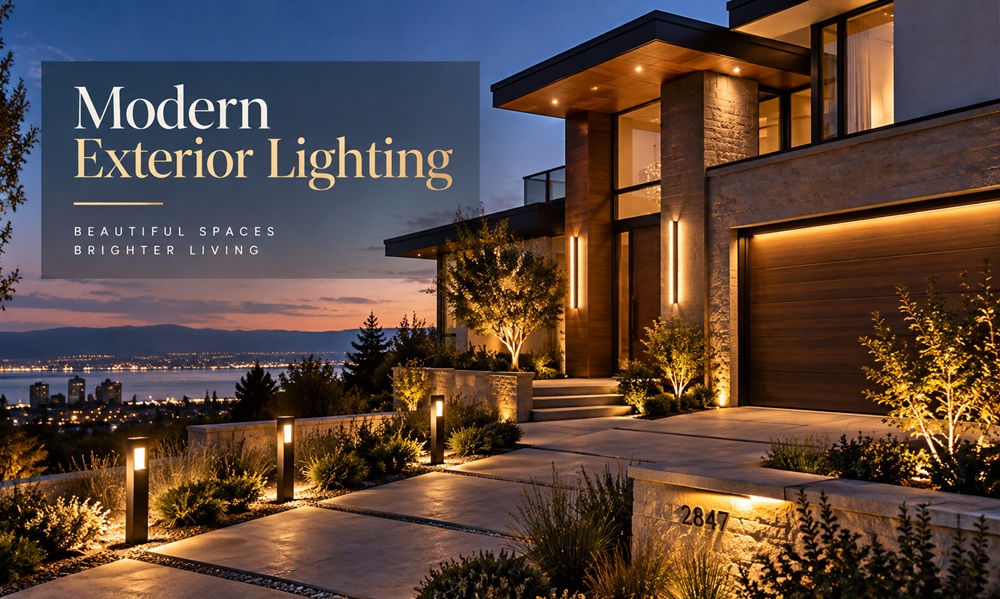
Modern exterior lighting is mostly about restraint. The best examples don’t show off the fixtures. They show off the house, with crisp edges, calm surfaces, and a handful of carefully placed highlights. If you can walk up the driveway and notice the building before you notice the lights, the design is working.
Hide the Source, Show the Effect
Traditional lighting often makes the fixture the star. Modern lighting reverses that. You want people to see the glow on a wall, the line along a step, or the warm wash across a canopy, but not the bright point that creates it.
That means choosing fixtures with recesses, diffusers, or shields that tuck the light source out of view. Under-eave downlights, slim soffit fixtures, and recessed step lights all fit this approach. Even where a fixture has to be visible, a simple form with a soft glow beats a bare bulb every time.
Follow the Lines of the House
Modern homes are built on strong lines such as flat roofs, long windows, deep overhangs, and clean corners. Lighting can reinforce them. A thin strip of light under a cantilevered roof draws attention to its shape. A row of small downlights beneath an overhang defines the edge of the house. A narrow light along the base of a wall separates it from the landscape and makes it appear to float.
The key is to pick one or two lines and emphasize them, not every edge. If everything glows, nothing stands out.
Let Materials Catch the Light
Modern exteriors often mix textures, such as wood slats, board-formed concrete, steel, glass, and stone. Light shows these differences. Grazing a vertical wood wall with warm light from above highlights the grain. A narrow beam along a concrete surface exposes its pattern. Soft light on a stone feature turns it into a focal point.
Glass changes the equation. Interior light spills outward through large windows and becomes part of the exterior scene, so think about how interior lamps and exterior fixtures will combine. Bright outdoor lights facing glass can create reflections that hide the view inside, so aim them away from windows when you can.
Treat the Landscape as a Second Wall
Plants and hardscape finish the picture. Uplighting a single tree or a sculptural plant gives the front yard a strong silhouette against the facade. Low path lights guide visitors without competing with the house. A few spotlights across a garden wall create depth that carries the eye from the street to the door.
Keep the planting layout in mind. Fixtures should light the most striking features, not every shrub. Leave some areas in shadow, because contrast is what makes the lit parts appear intentional.
Windows, Glass, and the Inside Out
Large windows are a defining feature of modern homes, and they change how exterior light behaves. At night, glass can turn into a mirror, so bright lights aimed at it bounce back and hide the interior. Place fixtures to the side of windows and aim them toward walls and landscaping rather than at the glass.
At the same time, interior light becomes part of the exterior composition. Warm lamps and recessed lights inside spill onto decks and lawns, so coordinate color temperature between inside and outside. If the interior lights are warm and the exterior ones are cold, the house looks like two different buildings.
Decks, Patios, and Outdoor Rooms
Modern homes often extend living space outdoors, and the lighting should feel like part of the house. Small downlights in a pergola or overhang give a soft, even glow over dining areas. Step and rail lights keep levels clear without adding glare. A single dimmable fixture on its own switch lets you adjust the mood for evening meals or late conversations.
Choose fixtures that can handle wet conditions and use the same finish as the house fixtures, so the outdoor room matches the architecture.
Keep It Dark Enough
One of the quiet signs of good modern lighting is a bit of darkness. Not every surface needs light, and bright floods can ruin the effect by flattening everything. Aim for a range of brightness, with the entry and steps a little brighter, accents softer, and large surfaces mostly left to ambient spill.
Shielded and downward facing fixtures also help reduce skyglow and keep light from drifting into neighboring properties. Many towns encourage this style, and some have rules about outdoor lighting, so it’s worth checking.
Color and Warmth
Most modern homes look best in warm white, usually between 2700K and 3000K, though some architects prefer slightly cooler tones around 3000K to 3500K for steel and glass. The more important point is to stay consistent. Mixing warm and cool fixtures across the same facade makes the house look patchy.
If you want flexibility, tunable white or dimmable fixtures can adjust the mood for different occasions, though they add cost and complexity. A reliable dimmer and a warm default setting are enough for most homes.
Controls Without Gadget Overload
Smart controls can make modern lighting easier to live with, as long as they stay simple. Set a schedule so entry and path lights turn on at dusk and dim late at night. Use motion sensors for side yards and rear doors. Create a few scenes, such as arrival, evening, and security, instead of programming a dozen.
Wiring should be neat. Hide cables in conduits and use fixtures with concealed connections. Because modern surfaces are clean, visible wires or exposed junction boxes ruin the look. For anything beyond a fixture swap, hire a licensed electrician who understands outdoor installation.
A Sample Plan for a Two-Story Modern Home
This isn’t a prescription, but it shows how the ideas fit together.
- Install slim wall fixtures beside the front door, with a house number lit nearby.
- Add recessed downlights under the front canopy or eave.
- Place small step lights along the main walkway and any change in grade.
- Uplight one or two feature trees or a textured wall.
- Add a sensor fixture over the garage and side access.
- Connect everything to a photocell or smart controller with at least two zones.
Six moves cover safety, security, and style without turning the house into a display.
Phasing the Project
Modern lighting rewards patience. Begin with the entry, steps, and garage, then add landscape accents after a few evenings of living with the first layer. That approach lets you judge brightness and color in real conditions and avoid buying fixtures you later decide you don’t need.
Common Missteps
A few errors repeat. Fixtures that are too bright make a quiet design feel loud. Too many different finishes break the visual rhythm. Spotlights aimed at windows cause glare and hide the interior view. And a plan made entirely from catalog images, without testing at night, rarely fits the actual house.
Test your plan with temporary lights before committing, and view it from the street, the driveway, and inside the house. Adjust until the result feels calm. When modern exterior lighting is done well, nobody says the lights are impressive. They say the house looks great, and that’s the better compliment.