

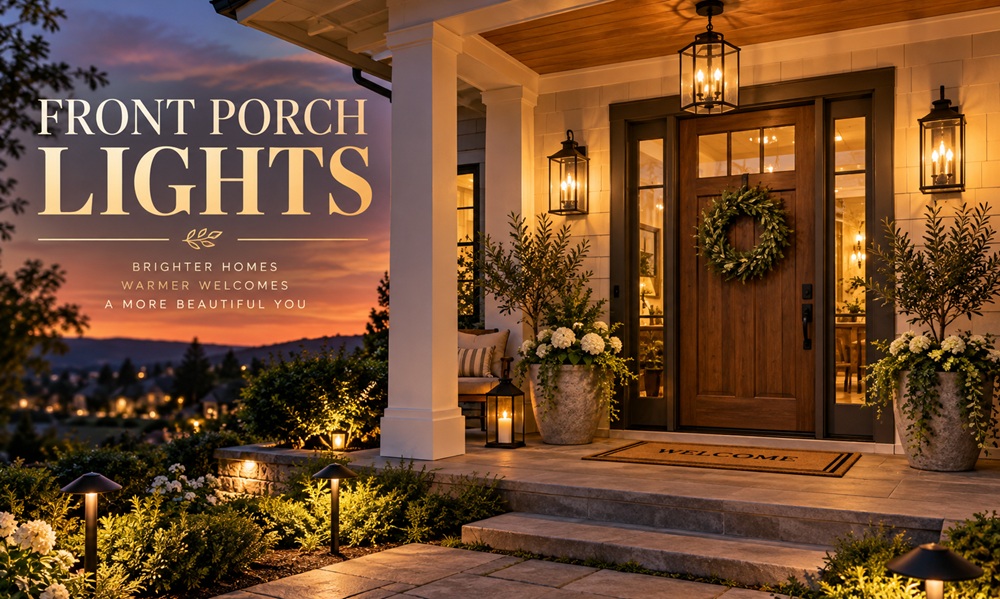
The best front porch lights do three jobs at once. They make the steps safe after dark, they help visitors and delivery drivers find the door, and they suit the style of the house. If you get size, brightness, and placement right, the style decision becomes the easy part, so that’s the order worth working in.
Decide What the Light Has to Do
Before you look at a single fixture, stand on your porch at night and notice what’s hard to see. Maybe it’s the top step, the house number, or the lock while your arms are full of groceries. A porch that mostly welcomes guests can get away with softer light. A porch that serves as the main entrance for a busy household, with a dark yard around it, needs more output and probably more than one fixture.
Most front doors look and work best with a pair of wall lights flanking the door, or one ceiling fixture if the porch is covered and deep. A pair balances the light on both sides and avoids the harsh one-sided shadows that a single lamp creates. If wall space is tight or the door sits off center, one well placed fixture on the latch side is a fair compromise, because that’s where you’re fumbling with keys.
Fixture Styles and the Houses They Suit
Style is the fun part, so here’s a quick way to narrow it down.
Lantern Style
Lanterns suit colonial, cottage, farmhouse, and other traditional exteriors. They usually have glass panels and a cap, and they come in finishes like black, bronze, and aged brass. Clear glass can make a bright bulb glare in your eyes, so look for frosted, seeded, or opal glass if you want a gentler glow at the door.
Modern and Minimalist Sconces
Cylinders, boxes, and slim bars fit contemporary and mid-century homes. Many of them throw light up, down, or both, which paints the wall instead of showing a bare bulb. That looks sharp, but it can leave the porch floor dimmer than you’d expect, so check that the steps still get real light.
Flush and Semi-Flush Ceiling Lights
On a covered porch, a flush mount keeps a low profile and works well when the ceiling is on the short side. Semi-flush fixtures hang a bit lower and feel more decorative. If anyone tall will walk under the light, lean toward flush.
Pendants and Hanging Lanterns
A taller porch can carry a hanging lantern, and it makes a nice focal point above the entry. It will move in strong wind, so pick one with a sturdy chain or rod, and make sure it hangs clear of the door swing.
Getting the Size Right
Small fixtures are the most common mistake. A pair of tiny lights beside a wide door looks like an afterthought, and they rarely put out enough light to matter.
A widely used designer guideline says wall lanterns should be roughly one quarter to one third the height of the door. On a standard 80 inch door that points to fixtures somewhere around 20 to 27 inches tall. It’s a rule of thumb rather than a law, so hold a cardboard cutout against the wall if you can’t picture it. For a wide double door or a tall entry, go larger or use a bigger pair.
Ceiling fixtures follow a similar logic. Match the scale to the porch itself. A small stoop wants a modest dome or lantern, while a deep, wide porch can take something with real presence, or two fixtures spaced evenly.
Brightness and Color
Brightness is measured in lumens, not watts. For an entry, many people land somewhere between 400 and 800 lumens per fixture as a rough starting range, depending on how many fixtures share the work and how dark the surroundings are. A pair of 500 lumen lights usually feels more welcoming than one 1000 lumen light, because the glare is lower and the coverage is wider.
Color temperature matters just as much. Warm white, around 2700K to 3000K, flatters brick, wood, and painted siding and feels inviting. Cool white above 4000K can make a front entry feel like a parking garage. Pick the same color temperature for every fixture on the front of the house so nothing looks mismatched when you stand at the curb.
LED bulbs are the practical choice for most porches. They last a long time, run cool, and use far less electricity than older incandescent bulbs, which matters for lights that burn every evening. If the fixture is enclosed, check the bulb packaging to confirm it’s rated for enclosed fixtures.
Where to Mount Front Porch Lights
Height changes how the light behaves. Many installers set the center of a wall fixture at about 60 to 66 inches above the porch floor, which is close to eye level and keeps the bulb from glaring straight into faces. Taller doors can justify going a little higher.
Place the lights about 6 to 12 inches out from the door frame so they don’t crowd it. If the siding is uneven, brick, or stone, a mounting block gives the fixture a flat base and a cleaner look. Keep both fixtures at the same height unless the porch layout makes that impossible.
Weather Ratings and Sensors
Front porch lights live outside, so the label matters. Fixtures listed for damp locations suit covered porches that don’t take direct rain. Fixtures listed for wet locations are meant to handle direct exposure, which makes them the safer pick for open stoops, and for walls that catch driving rain.
A few smart extras are worth considering.
- A dusk to dawn photocell turns the light on and off automatically, so you never come home to a dark porch.
- A built-in motion sensor can brighten the light when someone approaches, though many people prefer a steady glow at the door and motion lights for side areas.
- Smart bulbs and switches let you set schedules and dim the light for evenings.
If you already have a wall switch, a plug-in smart switch or a simple timer may be all you need.
Common Mistakes to Skip
Mismatched finishes are an easy way to cheapen a good entry. If your door hardware is matte black, your lights and house numbers should usually follow. Hanging a fixture too high creates a dark patch at the doorknob. Choosing a fixture that’s too small is the biggest error of all. Skipping the weather rating is the costliest, since moisture inside a fixture shortens its life and can create an electrical hazard.
Wiring is the other point where people get into trouble. Swapping a fixture is a job many homeowners handle with the power off at the breaker, but adding a new light where none existed, or working with old or damaged wiring, is a good moment to call a licensed electrician.
A Simple Way to Decide
Pick the style that suits the architecture, size the fixture to the door, aim for warm and moderate brightness, and confirm the weather rating before you buy. Do those four things and front porch lights will look intentional every night, not just in the showroom photo.