
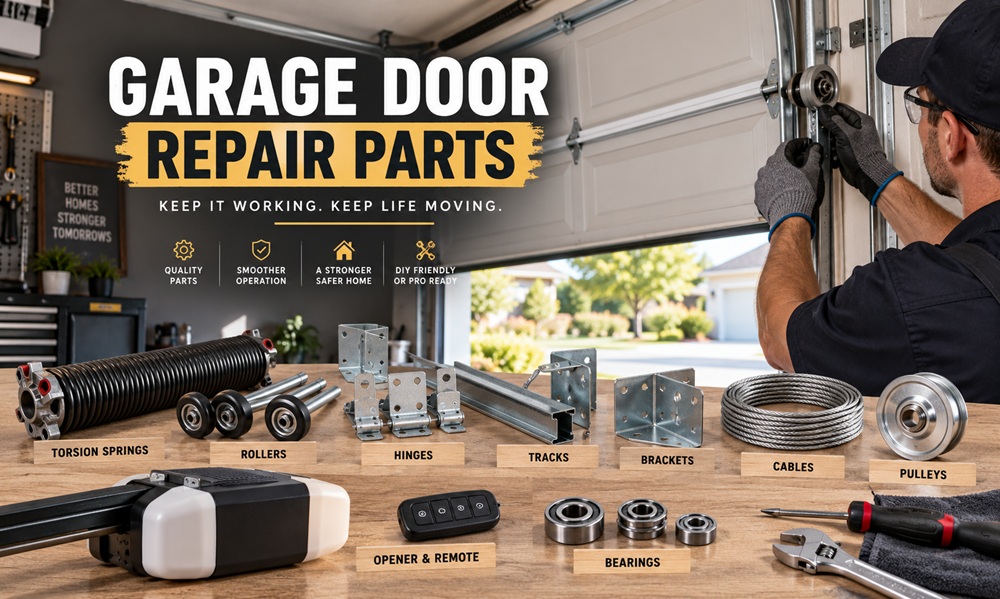
Your garage door looks like one big panel, but it’s really a system of moving parts working together every time you press the button. When the door groans, shudders, or stops halfway, one of those parts is usually the reason. Knowing the main garage door repair parts helps you describe the problem accurately, understand a repair quote, and decide what you can handle yourself.
Here’s a walk through the components that fail most often, grouped by the job they do.
The Parts That Carry the Weight
A residential garage door is heavy, and your opener was never designed to lift it alone. The balance system does that work.
Torsion Springs
Torsion springs sit on a metal bar above the door opening and twist as the door closes, storing energy that helps lift it back up. They wear out over time because every open and close cycle stresses the metal. Most eventually snap, and when one does, you’ll often hear a loud bang from the garage and find the door unable to open.
Replacement springs have to match the door’s weight, height, and the spring’s wire size, length, and inside diameter. Using the wrong spring can leave the door unbalanced or cause it to slam. Because these springs are under high tension, replacing them is work for a trained technician. Mistakes can cause serious injury.
Extension Springs
Some doors use extension springs, which run along both sides of the door tracks and stretch as the door lowers. They’re typically paired with safety cables that run through the spring to contain it if it breaks. If your door has these, make sure those cables are intact and secure.
Lift Cables
Cables connect the bottom corners of the door to the spring system. If one frays or slips off its drum, the door can tilt or hang crooked. Cables are under tension too, so don’t try to loosen or remove them without proper training.
The Parts That Guide the Door
Tracks and Brackets
Steel tracks on each side keep the door moving along its path. Dents, bends, or loose mounting brackets can make the door stick or jump out of alignment. Minor misalignment can sometimes be corrected by loosening the track bolts slightly and tapping the track back into position, but a track that’s visibly bent should be replaced.
Rollers
Rollers ride inside the tracks, and they’re one of the most affordable parts to replace. They come in steel, nylon, and sealed-bearing styles. Nylon rollers generally run quieter, while steel rollers are common on older or heavier doors. If your door rattles or sounds rough as it travels, worn rollers are a good first suspect.
Hinges
Hinges connect the door sections and let the door bend around the curve of the track. Cracked or loose hinges allow panels to sag and can eventually damage the door itself. Hinges are numbered by position, and the numbers matter because the ones at the ends differ from the ones in the middle.
The Parts That Make It Automatic
Opener Motor and Drive
The opener has a motor, a drive system (chain, belt, or screw), and a logic board. A humming motor with no door movement points to a problem with the drive, springs, or limit settings rather than the motor alone. A stripped gear or worn drive is a common issue on older units.
Remote, Keypad, and Receiver
If the door responds to the wall button but not the remote, the issue is usually a dead battery or a remote that needs reprogramming. If nothing responds, check the power source and the receiver before suspecting the main unit.
Safety Sensors
The two small sensors near the floor on either side of the door send an invisible beam across the opening. If something blocks the beam or the sensors get knocked out of alignment, the door will refuse to close or will reverse. Wiping the lenses and rechecking their alignment solves the problem more often than people expect.
The Parts That Seal and Protect
Weatherstripping and Bottom Seal
The rubber strip along the bottom of the door keeps out water, leaves, and drafts. It hardens and cracks over the years. Replacing it is simple on most doors and makes a noticeable difference in how the garage feels.
Panels
Dented or cracked panels can sometimes be replaced individually, but matching color and style gets harder as a door ages. If the manufacturer no longer produces your panel design, a full replacement may be more practical.
Matching Symptoms to Likely Parts
| What you notice | Parts most likely involved |
|---|---|
| A loud bang followed by a door that won’t lift | Torsion spring |
| Door hangs crooked or one side drops | Lift cable, drum, or track |
| Grinding or rattling during travel | Rollers, hinges, or track |
| Door reverses before closing | Safety sensors or close force settings |
| Opener hums but the door stays put | Springs, drive gear, or limit settings |
| Gaps of light or drafts at the floor | Bottom seal or weatherstripping |
This is a starting point rather than a diagnosis. Several parts can produce the same symptom, which is why a professional inspection is worth it before buying anything expensive.
Buying Replacement Parts the Right Way
Start by finding the door’s make and model, usually printed on a label inside the door or on the opener housing. Note the door’s dimensions and weight, and photograph the old part from several angles before removing it.
Original manufacturer parts tend to fit exactly, while aftermarket versions can cost less and work well for common items like rollers and seals. For springs and cables, precision matters more than price, so rely on measurements instead of guesswork. Pricing varies by brand, size, and region, so compare a few suppliers instead of assuming a standard cost.
Be careful with parts that look similar but aren’t. Rollers come with different stem lengths and wheel sizes, and hinges differ in gauge. A part that almost fits can cause more damage than a worn one.
What You Can Do Yourself and What to Leave Alone
Homeowners can reasonably handle battery swaps, sensor cleaning, lubrication, weatherstripping, and roller replacement on some doors. Lubricate rollers, hinges, and springs once or twice a year with a garage door lubricant rather than a general-purpose grease that attracts dirt.
Springs, cables, and anything attached to the balance system should be left to professionals. The tension involved is powerful enough to cause serious injury.
Keeping Parts Working Longer
A quick monthly check goes a long way. Watch and listen as the door runs. Look for frayed cables, gaps in the weatherstripping, loose bolts, and uneven movement. Test the balance by disconnecting the opener with the door closed and lifting it by hand partway, since a properly balanced door should stay in place instead of dropping or flying up. If it doesn’t, call someone before the next cycle makes it worse.
Garage door repair parts are individually simple, but they depend on each other. Replacing the right one at the right time keeps the whole system working, and keeps a small repair from becoming a full replacement.