
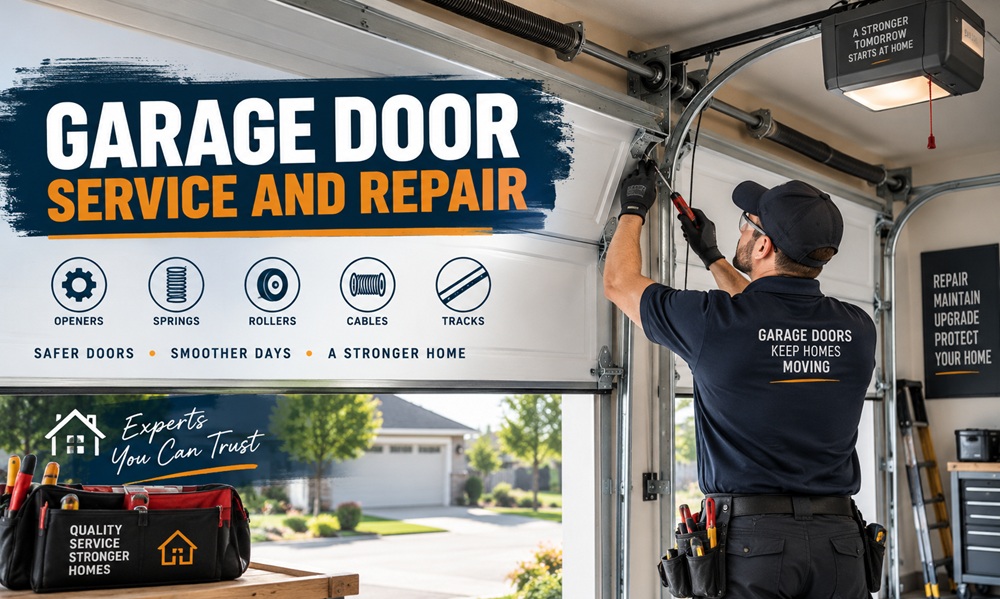
Most people only think about their garage door when it stops working, usually at the worst possible time. Garage door service and repair covers a wide range of work, from a routine tune-up that keeps things running smoothly to a mid-morning rescue when a spring breaks. Understanding what each type of visit involves helps you spend money where it counts and avoid paying for work you don’t need.
Service Versus Repair
The two terms get used interchangeably, but they mean different things.
Service is preventive. A technician inspects, adjusts, lubricates, and tests the door and opener before anything fails. Repair is corrective. Something has already broken, jammed, or worn out, and it needs to be fixed or replaced.
Many companies bundle the two. A repair visit often includes a quick inspection of the rest of the system, and a service visit can turn into a repair if the technician finds a worn part. That’s usually a good thing, as long as the technician explains what they found and why it matters.
What a Typical Service Visit Includes
A thorough maintenance visit usually looks at the whole system instead of one component.
- Springs, cables, and drums are checked for wear, fraying, or uneven tension.
- Rollers, hinges, and brackets are inspected, tightened, and replaced if damaged.
- Tracks are checked for alignment, dents, and loose mounting.
- Moving parts are lubricated with a product made for garage doors.
- The opener’s force and travel settings are tested and adjusted.
- Safety sensors are tested, and the auto-reverse feature is confirmed.
- The door’s balance is tested with the opener disconnected.
If a technician skips the balance test or the safety reverse check, ask why. Both are basic parts of a proper visit.
Common Repairs and What Causes Them
Broken Springs
Springs are built to last a finite number of cycles, and when they reach the end of their life, they break. The usual signs are a loud bang, a door that feels extremely heavy, or an opener that strains without lifting anything. Spring replacement should always be done by a professional, since the tension in a wound spring can cause serious injury.
Off-Track Doors
A door that jumps its track is often the result of a bent track, a broken roller, or a car bumping the door. Don’t try to force it back into place. Forcing a door that’s off its track can bend panels or damage cables.
Noisy Operation
Squealing, grinding, and rattling usually come from dry or worn rollers and hinges, or from a chain drive that needs adjusting. Noise is the door’s way of telling you something needs attention before it becomes a breakdown.
Opener Problems
If the door responds inconsistently, the cause could be as simple as sensor alignment or remote batteries. Other times it’s a failing logic board or a worn gear. A good technician tests the easy possibilities first before recommending a replacement unit.
Damaged Panels and Seals
Dents from impact, cracked panels, and worn bottom seals are cosmetic in some cases and functional in others. A panel that’s cracked can weaken the whole section, so it’s worth having it looked at.
Repair or Replace the Door?
Repairing is usually the better choice when the problem is limited to a single part and the rest of the door is in sound condition. Replacement starts to make sense when several things are wrong at once.
Think about replacement if:
- Multiple panels are damaged or warped.
- The door is old enough that parts are hard to find.
- The door is poorly insulated and your garage is attached to living space.
- Repair costs are approaching the price of a new door.
- The door has a history of repeated problems that keep returning.
If you’re unsure, ask the technician for both options in writing, including the likely lifespan of each. A reputable company won’t push you toward the more expensive one without a reason.
What Affects the Cost
There’s no single price for garage door service and repair, since several factors shape the final bill.
The type of part matters a great deal. Replacing a roller is a small job, while replacing springs or a full opener is a larger one. The size and weight of the door change which parts are needed. Local labor rates differ by region, and after-hours or emergency calls usually cost more than scheduled appointments.
The condition of the rest of the system also matters. If worn cables and rollers are replaced at the same time as a broken spring, you may pay more on the day but save a second visit later.
Ask for an itemized estimate before work starts. It should list parts, labor, and any service call fee, so there are no surprises.
Choosing a Technician You Can Trust
A few simple checks make a real difference.
Start with the basics. A legitimate company should have a verifiable business address, proper licensing where your state or city requires it, and insurance. Ask whether the technicians are employees or subcontractors, and whether the company stands behind the work with a written warranty on parts and labor.
Pay attention to how the first phone call goes. Good companies ask about your door type, symptoms, and age before suggesting what might be wrong. Be cautious with anyone who quotes a firm price without hearing any details, or who pressures you to approve a major replacement on the spot.
When the technician arrives, a trustworthy one will show you the damaged part, explain what failed, and give you options. Take a moment to compare that explanation with what you saw and heard before the problem occurred.
Maintenance You Can Handle Between Visits
You don’t need professional tools to keep an eye on things.
Once a month, open and close the door and watch for jerky movement or unusual sounds. Look at the cables and springs without touching them. Check that the sensors are clean and aligned, and wipe the lenses if they look dusty.
Test the auto-reverse by placing a roll of paper towels or a piece of wood on the floor where the door will close. The door should reverse as soon as it touches the object. If it doesn’t, stop using the opener and call for service.
Lubricate moving parts twice a year. Use a product intended for garage doors, and avoid heavy grease that collects dust.
How Often Should the Door Be Serviced?
Many professionals suggest a yearly inspection, though homes with heavy daily use may benefit from more frequent checks. A family that opens the door several times a day wears out parts faster than someone who parks outside most of the time.
What matters most is catching small issues early. A frayed cable or a loose bracket costs very little to correct today and a lot more after it fails.
A Practical Way to Think About It
Treat your garage door the way you’d treat a car. It’s one of the largest moving objects in your home, it runs on tension and electricity, and it works hardest when you’re in a hurry. A little regular attention, plus a technician you trust for the dangerous parts, keeps garage door service and repair a manageable line item instead of a surprise emergency.