

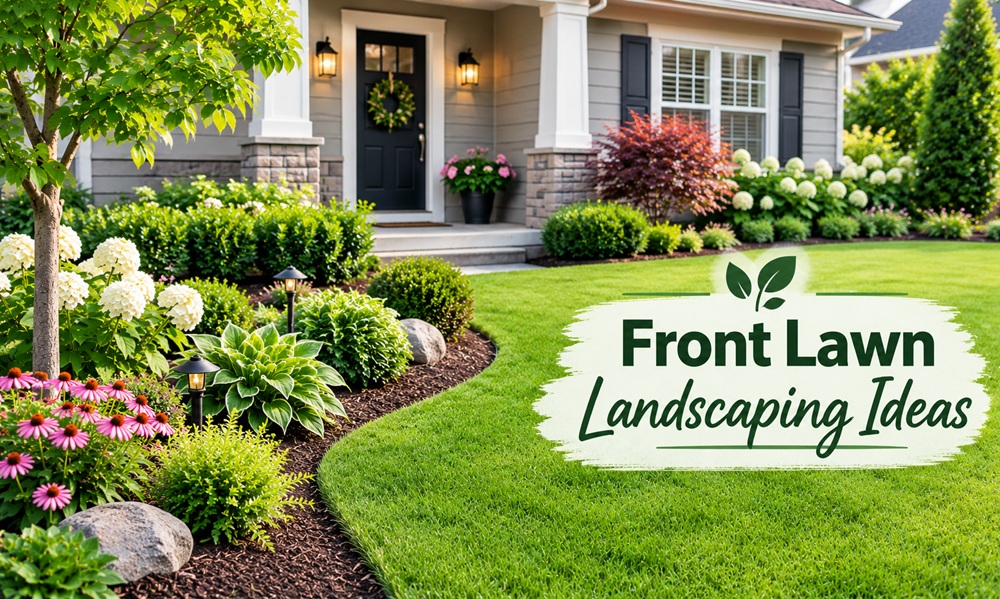
A lawn on its own is a green rectangle. It’s tidy, sure, but it doesn’t say much about the house behind it. The good news is that you rarely need to tear everything out to fix that. Most front lawn landscaping ideas work by giving the grass a frame, a focal point, and a few layers of interest around the edges.
Here’s how to do that without turning your yard into a project that never ends.
Give the lawn a shape worth looking at
Straight edges feel formal and square lots tend to look boxy. A gently curved lawn edge softens the whole front of the house and makes the yard feel larger than it is. You can test a curve before you commit by laying a garden hose on the grass and nudging it until the line looks right from the street, the front door, and the living room window.
The curve should be generous. Tight wiggles look fussy and are miserable to mow. Aim for long, sweeping arcs that follow the walkway or sweep out from the corner of the house, then cut the new edge with a flat spade or mark it with spray paint first.
Plant beds that work with the grass
A lawn feels more intentional when it has something to push against. Two kinds of beds do most of the work.
A foundation bed runs along the front of the house and ties the building to the ground. Layer it from back to front, with taller shrubs or ornamental grasses near the wall, medium perennials in the middle, and low plants along the edge. Keep the bed deep enough for that layering, usually at least four or five feet, otherwise everything ends up crammed into a single row.
An island bed sits out in the lawn, often anchored by a small tree or a cluster of shrubs. It breaks up a large expanse of turf and gives you somewhere to add color. Make it an irregular oval rather than a perfect circle, and leave enough mowing room around it that the mower can pass without scalping the edges.
Let one tree do the heavy lifting
If your front lawn feels empty, a tree is probably the answer. A well placed tree adds height, shade, and a natural focal point that no shrub can match. Flowering dogwood, crabapple, serviceberry, and Japanese maple are popular choices in many regions, though what thrives depends heavily on your climate and soil.
Placement matters as much as species. Keep it far enough from the house, driveway, and sidewalk that mature roots and branches won’t cause trouble, and look up for power lines before you dig. Offsetting the tree slightly rather than centering it makes the composition feel more natural. Plant it, mulch a wide ring around the trunk so you aren’t mowing right up to the bark, and the lawn will look better the moment it’s done.
Edging is the cheapest upgrade
Few things change the look of a front yard as quickly as a crisp edge between lawn and bed. Without one, grass creeps into the mulch and the whole yard looks softly neglected even when it isn’t.
You’ve got several options. A simple trenched edge, cut with a spade, costs almost nothing but needs recutting every season. Steel or aluminum edging holds a clean line for years and nearly disappears from view. Brick, stone, or concrete edging adds a visible design element and suits cottage and traditional homes especially well. Pick one that fits the style of your house and use it consistently around the yard.
Cut a path across the grass
Plenty of front yards have a straight concrete walk and nothing else. If people already cross the lawn to reach the door, or if the walk feels cold and utilitarian, consider adding a secondary route. Stepping stones set into the grass give a casual, cottage feel and are one of the easier DIY jobs here. A curved paver or gravel path takes more effort but makes the yard feel designed rather than defaulted.
Set stones so your stride lands naturally on each one, which usually means centers about two feet apart, and sink them level with the soil so the mower rolls right over.
Plan color so it shows up all year
Front lawn landscaping looks best when something is always happening somewhere in the beds. Spring bulbs such as daffodils and tulips can be tucked in the fall and come up before most perennials wake. Summer belongs to reliable bloomers like coneflower, black eyed Susan, hydrangea, and daylily, depending on where you live. Fall can carry the show with ornamental grasses, sedum, asters, and the foliage of shrubs that turn red or gold.
A simple approach helps here. Choose two or three main colors and repeat them across the yard. A palette of white, purple, and silver green feels calm, while orange, yellow, and deep red feels warm and lively. Repetition ties scattered beds together much more effectively than a dozen unrelated flower colors.
Light the yard after dark
A front lawn disappears at night unless you give it something to show. Low voltage landscape lights along the path, a few uplights aimed at a tree, and a soft glow at the entry make the yard feel welcoming and safer to walk through. Solar path lights are an easy start and need no wiring, though they tend to be dimmer and less reliable through dark winter months than a wired low voltage system.
Keep fixtures modest. Aim the light at what you want to show off, not out toward the street, and avoid bright glare that shines into neighbors’ windows.
When the lawn itself is the problem
Sometimes the grass is the weak point. A thin, patchy lawn under heavy shade, on a steep slope, or in a spot that never drains properly will fight you no matter how much you reseed. In those cases, it often makes more sense to change the surface than to keep trying.
Shade tolerant groundcovers, a mulched woodland bed, or a small patio can replace the worst areas. Some homeowners overseed with clover or a mix of low growing fescues, which use less water and tolerate imperfect conditions. Others convert a section to a native meadow patch, though neighborhood rules matter here, so check your homeowners association guidelines and local weed ordinances before you rip up turf.
Keep a reasonable amount of lawn if you can. Open green space is what makes planted beds read as deliberate, and it gives kids and pets room to move.
Watch proportions as you go
The most common mistake in front yard design is balance. If beds take over, the yard feels cluttered and the lawn turns into a narrow strip nobody can use. If plants hug the house in a single skinny row, the planting looks like an afterthought.
A good rule of thumb is to let the lawn stay the largest single open area, then make planting beds noticeably deeper than they first seem necessary. Step back to the street every so often while you work and look at the whole composition, not just the patch you’re digging.
Start small and build
You don’t have to do all of this at once. Reshape the edge this month, add a bed next season, and plant the tree when the weather suits it. A front lawn that grows into its design over a year or two usually ends up looking better than one finished in a single frantic weekend, because you’ve had time to see how the light moves and where the water goes.