
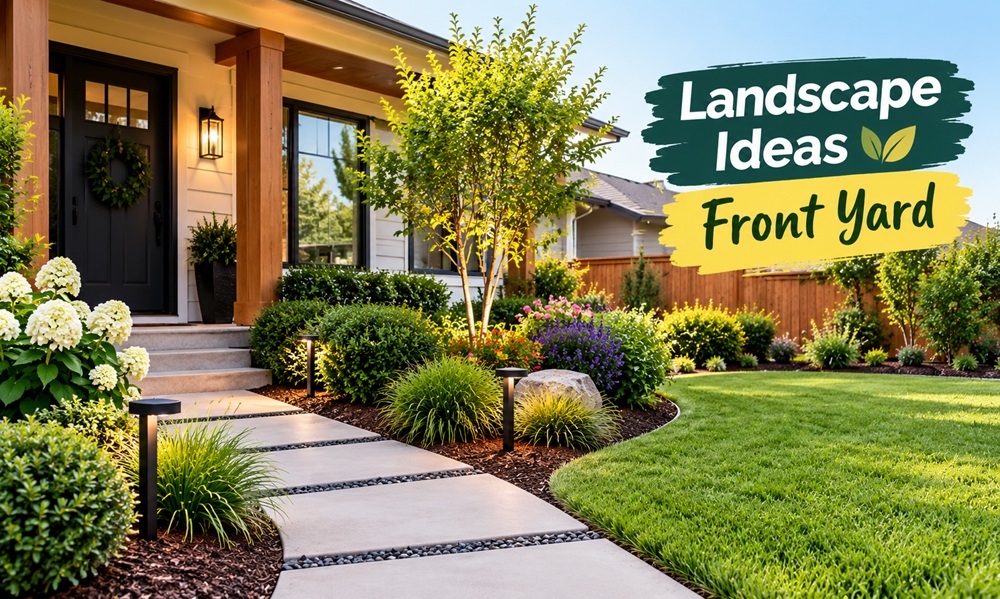
Looking for landscape ideas front yard owners can actually use? Start with what your house and lot are already telling you. A brick Colonial, a stucco ranch, a narrow city townhouse, and a sloped hillside lot all call for different answers, even if the same plants could grow in all of them.
So instead of a random list, here are ideas grouped by style and by common yard problems. Find the one closest to your situation and borrow freely from the others.
Cottage garden
Soft, overflowing, and a little unruly on purpose. A cottage front yard leans on masses of flowering perennials, a picket or low stone border, and winding paths made from brick or gravel.
Plant in loose drifts of foxglove, delphinium, lavender, roses, and catmint if your climate allows, and let a few self seeders wander. Climbing roses or clematis on a simple arbor over the gate finish the look. The catch is upkeep. Cottage gardens look best with regular deadheading and a willingness to edit as plants spread.
Modern and minimal
Clean lines, limited plant varieties, and strong shapes. Think wide concrete or stone pavers, a gravel or low groundcover panel instead of lawn, and a few sculptural plants repeated in tidy groups.
Ornamental grasses, agave in warm regions, boxwood or yew clipped into simple forms, and a single specimen tree work well. Keep the palette tight, usually green with one or two accent colors. Because the design depends on precision, edges and spacing matter more here than anywhere else.
Traditional and symmetrical
For brick homes, Colonials, and Georgians, symmetry usually looks right. Mirror plantings on either side of the front door, line the walk with evenly spaced shrubs, and use clipped hedges to define the edges.
Evergreens like boxwood, holly, and yew give year round structure, while hydrangeas or roses add seasonal color. Planters flanking the entry add a formal touch. The approach is easy to read and to maintain, though it depends on pruning to keep its crisp look.
Dry climate and water wise
Where rainfall is scarce, or you’re simply tired of watering, lean on plants adapted to dry conditions. Gravel mulch, boulders, and drought tolerant shrubs and perennials give a front yard a distinct regional character.
Depending on where you live, that might mean lavender, salvia, yarrow, ornamental grasses, succulents, or native shrubs. Group plants with similar water needs, water deeply but infrequently once they’re established, and use drip lines rather than sprinklers. Dry doesn’t have to mean barren. Layering heights and mixing leaf textures keeps it lively.
Woodland and shade
Mature trees can make traditional lawns miserable, so work with the shade instead. A woodland front yard uses ferns, hostas, hellebores, astilbe, and native understory shrubs under the canopy, with a winding mulched or stepping stone path.
Leaf color and texture matter more than flowers here, so combine large and fine foliage, and silver or variegated leaves to brighten dim corners. Check how much root competition exists before digging in, since heavy tree roots can limit what you can plant and how deep you can go.
Small front yards
A tiny yard has less room for mistakes, but it also needs less to look good. Skip the lawn and use the space for a simple, layered planting bed, a compact tree, and a path that gets you to the door in a pleasing way.
Vertical elements stretch the space. Trellises, a narrow climbing vine on the wall, or tall, slender shrubs draw the eye up. Containers by the door let you swap seasonal color without digging. Limiting the plant list to a handful of varieties keeps a small space from feeling cluttered.
Sloped front yards
Slopes drain quickly, wash out soil, and make mowing awkward. They also give you the chance to design something more interesting than a flat lot.
Terraced beds held by low retaining walls create planting steps and slow runoff. Where walls aren’t practical, deep rooted groundcovers and shrubs hold soil far better than turf. Install the plants through erosion control fabric or a thick layer of mulch on new slopes, and water carefully so new roots establish. Walls over a certain height often need engineering and permits, so check local rules before building.
Corner lots and busy streets
If your front yard is exposed to traffic and passersby, privacy and noise might be as important as looks. Layered plantings of evergreen shrubs and small trees soften the view, and a low hedge or fence defines your space without making the house feel walled off.
Keep plants near the intersection low enough that drivers can see around the corner. Many cities have sight triangle rules that limit height near corners, so it’s worth a quick call to your local planning office.
Pollinator and edible front yards
Front yards don’t have to be purely ornamental. A pollinator planting built around native flowers such as coneflower, bee balm, milkweed where it’s native to your region, and asters gives bees and butterflies food from spring through fall, and it looks full and colorful when you group plants in generous drifts.
Edibles can work out front too, especially in a sunny yard where the backyard is shaded. Blueberries, herbs, rhubarb, and compact fruit trees are attractive enough to sit in a foundation bed. Keep them tidy with clear edging, and check homeowners association rules first, since some neighborhoods restrict front yard vegetables or limit plant height.
Matching an idea to your yard
If you’re torn between directions, this comparison can help narrow things down.
| Situation | Ideas that tend to fit |
|---|---|
| Traditional brick or Colonial home | Symmetrical beds, clipped evergreens, a formal walk |
| Craftsman or bungalow | Cottage style beds, native perennials, natural stone |
| Contemporary or mid century home | Minimal planting, gravel or paver panels, grasses |
| Little time for upkeep | Water wise plantings, groundcover, mulch, drip irrigation |
| Heavy shade | Woodland planting, textured foliage, stepping stone path |
| Steep or uneven ground | Terraced beds, deep rooted shrubs, groundcover |
Small additions that work in any style
A few touches suit nearly every front yard. A defined entry path with some width to it. A tidy house number and mailbox. A pair of planters or a bench by the door. Soft low voltage lighting along the walk. Even something as small as repainting the front door in a color that complements your plantings can pull things together.
Think about the driveway side of the yard as well. Many front yards hide their best planting behind a parked car. A narrow bed of shrubs and grasses along the driveway edge, or a change in paving where the drive meets the walk, softens a big expanse of concrete and makes the whole entry feel considered. If you have a garage facing the street, a pair of tall planters or a small tree off to one side can pull attention toward the front door instead.
Pay attention to what’s visible year round, too. A yard that looks good in May but empty in January needs a few evergreens, interesting bark, or winter berries to carry the colder months.
Choosing your direction
Walk to the curb and look back at your house. What does it already do well, and what feels missing? The right landscape tends to echo the architecture, suit the site conditions, and match the amount of time you’re willing to spend outside. If an idea fits all three, it’s probably a good one. If it only looks nice in a photograph, think twice.