

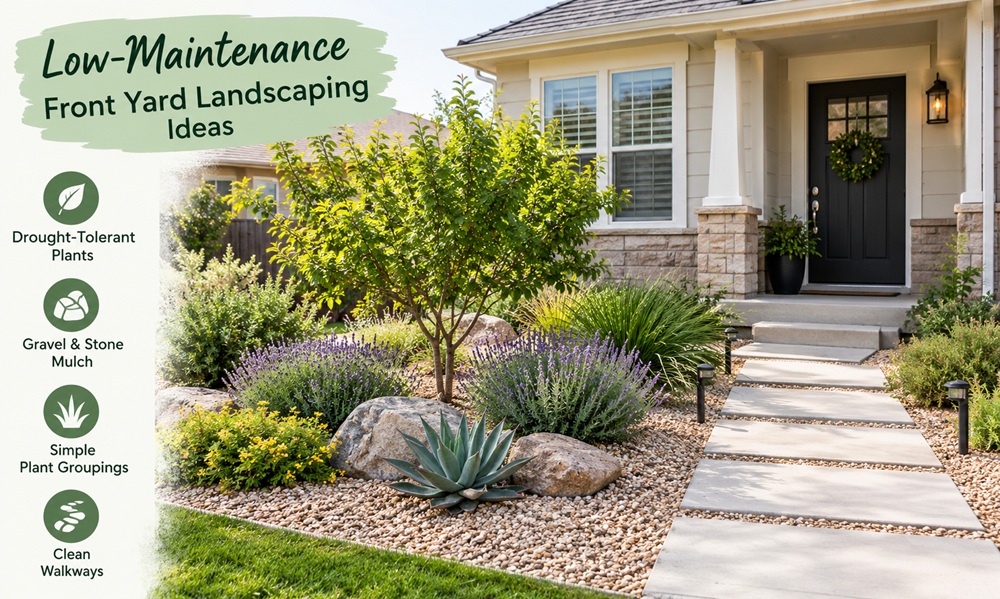
The best landscape ideas for front of house low maintenance share three traits. They use less lawn, they rely on plants that already like your climate, and they cover the soil so weeds and watering stop eating your weekends. Get those three things right and the front of your home can look tidy for most of the year with only a few short chores each season.
The ideas below are written for homeowners who want curb appeal without a standing appointment with a mower. Plant choices vary a lot by region, so treat the plant names as starting points and check what grows well locally before you buy.
Start by finding out what actually takes the time
Most front yard upkeep comes from a short list of jobs. Mowing and edging a lawn. Trimming shrubs that outgrew their spot. Pulling weeds from bare soil. Watering plants that were never suited to the site. Raking leaves out of beds crowded with tiny features.
Once you see the chores laid out like that, the fixes get obvious. Shrink the lawn, choose plants that stay the size you need, cover the soil, and match each plant to the sun and water it will really get. A low maintenance yard is mostly the result of removing causes of work rather than adding clever features.
Eight ideas that cut the workload
Shrink the lawn instead of removing it
You don’t have to give up grass entirely. A smaller lawn with a simple shape still gives the eye a place to rest, and it mows far faster than a yard full of tight corners. Turn the outer areas into planting beds or groundcover and keep the remaining turf as a clean rectangle or a gentle curve.
Use groundcover where grass struggles
Shady slopes, narrow strips beside the driveway, and dry corners are where grass gives up first. Low spreading plants can fill those spots once they’re established. Creeping thyme suits sunny, well drained areas, while sedges and ajuga often do better in partial shade. Ask a local nursery which groundcovers behave in your area, since a few spread more aggressively than you’ll want.
Build beds around slow growing shrubs
Pick shrubs whose mature size matches the space you’ve given them. A dwarf evergreen won’t need constant shearing, while a plant that wants to be ten feet wide will fight you every season in a three foot bed. Read the mature width on the plant tag, not just the height, and leave room for that growth.
Mix ornamental grasses with long season perennials
Many ornamental grasses need only one cutback in late winter, and they add movement and texture to an otherwise static bed. Pair them with sturdy perennials such as sedum, daylilies, salvia, or coneflowers where the climate suits them. Repeating a few plants in drifts looks calmer and takes less planning than a bed holding one of everything.
Cover every bed with mulch or gravel
Bare soil invites weeds. A layer of shredded bark or wood chips about two to three inches deep blocks light, holds moisture, and breaks down to feed the soil over time. In dry regions, gravel or decomposed granite can be a better match. Whichever you choose, keep it pulled back from stems and trunks so moisture doesn’t sit against the bark.
Add drip irrigation or soaker lines
Hand watering is one of the biggest time sinks in any yard, and sprinklers tend to wet the pavement as much as the plants. Drip lines deliver water slowly to the roots, and a basic timer removes the daily decision. New plantings usually need regular water for their first season or two, so a drip system pays for itself quickly in saved effort.
Let hardscape provide the structure
A well laid path, a gravel border, or a low retaining wall gives the yard shape that never needs trimming. Pavers or compacted gravel on a walkway don’t need mowing, and a crisp edge of steel, stone, or brick keeps mulch off the lawn. Hardscape costs more at the start than planting does, but it’s the most permanent part of a low effort front yard.
Plant one or two trees rather than five
A single small ornamental tree can anchor the whole front yard. Place it well away from the foundation, utilities, and overhead lines, and choose a species whose mature size fits the space. Think about leaf drop, fruit mess, and root behavior near paving too. Fewer, better chosen trees mean less pruning and less cleanup year after year.
Comparing ground surfaces
Choosing what covers the ground is the single biggest decision for upkeep. This quick comparison shows how common options behave.
| Surface | Works best for | Upkeep to expect |
|---|---|---|
| Lawn grass | Small, simple areas people actually walk on | Regular mowing, edging, and seasonal feeding |
| Groundcover plants | Shade, slopes, and awkward strips | Weeding while young, light trimming once filled in |
| Shredded bark mulch | Planting beds in most climates | Topping up every year or two |
| Gravel or decomposed granite | Dry climates, paths, and modern designs | Raking and occasional weed control |
| Pavers | Walkways and small seating spots | Sweeping and pulling weeds from joints |
Choosing plants that behave
Native and well adapted plants are usually the least demanding because they’re already tuned to local rainfall, soil, and temperature swings. That doesn’t mean you’re limited to a plain look. Many regions have a surprising range of native shrubs, grasses, and flowering perennials.
Before shopping, spend a day noting how many hours of direct sun each part of the front yard gets. Check how quickly water drains after rain, and find your hardiness zone. A plant labeled full sun will sulk in a shady corner no matter how much you fuss over it, and a plant that needs steady moisture will struggle against a south facing wall. Matching the plant to the spot does more for low maintenance than any product you can buy.
Keep the plant list short. Five or six varieties repeated across the bed look intentional, and they’re easier to care for because they share similar needs.
Mistakes that bring the work right back
A few common slips turn an easy yard into a demanding one.
- Planting too close together because small nursery plants look sparse. Spacing for mature size feels empty for a year or two, but it saves you from constant pruning and thinning later.
- Skipping soil preparation. Loosening compacted soil and mixing in compost before planting gives roots a better start, especially around new construction where the ground is often packed hard.
- Choosing fast growing plants for quick results. Speed usually means more trimming.
- Leaving out an edge. Without a clear border between lawn and bed, grass creeps in and you’ll be re-cutting the line all summer.
- Scattering too many small beds. Fewer, larger beds with clean shapes are quicker to mulch, weed, and water.
A simple seasonal routine
Even a well designed low maintenance yard needs some attention, just far less of it. In spring, top up mulch where it has thinned, cut back ornamental grasses if you haven’t already, and check that irrigation lines and emitters are working. Through summer, pull the occasional weed while it’s small and make sure new plants get their water. In fall, clear leaves from beds and the lawn, and adjust your irrigation timer as the weather cools. Winter is a good time to prune dormant shrubs that need it and to plan any changes for next year.
When it makes sense to bring in a professional
Some jobs are worth handing off. Grading and drainage problems can damage a foundation if they’re handled poorly, and removing or planting large trees carries real safety risks. Irrigation installation, retaining walls, and electrical work for lighting are also better handled by licensed or experienced contractors in many areas. Local rules may require permits for walls above a certain height or for work near utility lines, so check with your city or county before you start.
Where to begin
Look at your front yard this weekend and name the one chore you dislike most. If it’s mowing, start by converting a section of lawn into a mulched bed with a few tough shrubs. If it’s weeding, mulch and groundcover come first. If it’s watering, drip irrigation is the place to put your money. Solving one problem at a time spreads out the cost and lets you see what works before you commit to the whole yard.